
If it’s Trending, it’s Already Out of Style
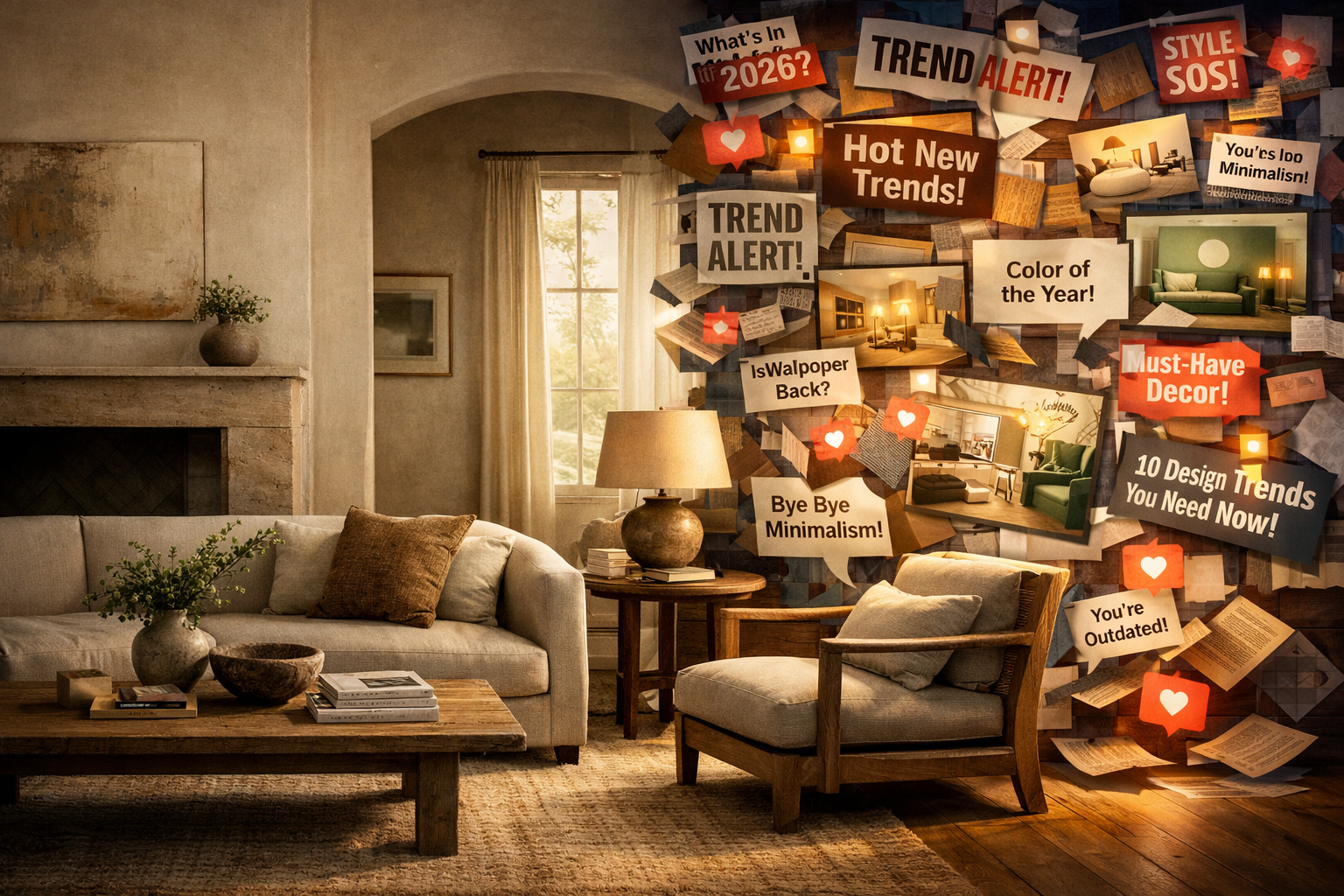
Picture it: You’ve presented a beautiful design scheme, after countless hours of discovery, research, sketching, scheming and sourcing. Everything was designed with care and restraint, honest materials. The proportions were right. The timeless palette was rich and layered but wholly balanced. The space felt intentional, complete.
Then the client looks at you and says, “I thought wallpaper was out; is it coming back?”
Silence.
“I mean, I love all of this but I saw some trend forecasts and I’m wondering if we should change a few things.”
This scenario, or one similar to it, has happened more times than I’d like to admit.
After years of dealing with this, I’ve realized it’s not a design problem but rather trend-driven anxiety, and it’s everywhere.
In a trend-focused society, interior design has become an aggressive playground. Scroll for a few minutes, and you’ll be told what color is “in,” what finish is “having a moment,” what pattern is “back,” and what style is “officially over.” Every year comes with a new set of predictions: What We’ll See in 2026, The New Neutrals, The Return of Warm Woods. These headlines are packaged as expertise, but what they really create is low-grade panic that suggests if you don’t pivot, repaint, replace, refresh, or redo, you’re behind.
Here’s the truth we want to say plainly: if it’s trending, it’s already out of style.
A trend, by definition, is something that has moved past the point of personal discovery and into mass adoption. It is no longer an idea living in context; it is an idea being repeated. That doesn’t make it “bad,” but it’s important to understand the definition and distinctions.
Historically, trends moved slowly and were tied to real cultural and economic shifts. Design movements emerged from changes in technology, societal needs, and the artistic spirit of a time. Victorian-era design, a move away from Georgian design, started in Britain and became prominent in the U.S. when the Industrial Revolution and the expansion of the railway system allowed for the mass production and quick transport of building materials like specialized woodwork, shingles, and glass. Deco grew from industrial optimism and a fascination with progress. Mid-century modern was propelled by new materials, new manufacturing techniques, and a post-war desire for practicality and clean lines.
So, trends have always existed, but it’s the speed at which they spread, and how they rise to popularity that makes them concerning at times. Today, many trends don’t rise because they are the most thoughtful or the most appropriate, but because they circulate well, photograph well, and are easy to replicate.
The media, of course, does not help. Trend forecasting is often presented as design expertise, but in most cases it is more closely tied to product cycles than it is to design principles. When you read a headline about what’s hot (or not) for the coming year, what you are often seeing is a preview of what manufacturers want to sell and what retailers want to move. That ecosystem depends on urgency, on making people feel like their homes are outdated, and encouraging constant change.
The content creators are brought in to spread the word, converting former design movements rooted in cultural evolution into algorithm-friendly trends. Most disturbingly, these “new” trends are often propagated by non-experts - people with next to no understanding of design or design history - to tell you what your home “should” be in order to sell products.
That might work for the content machine, but it is the opposite of what we are trying to create for our clients. This is one of the main reasons we stay away from trends in our interior design work — at least in the way they are typically employed. I’m not saying leaning into trends should be forbidden, but the trick is making them feel timeless, ensuring they are appropriate for the space and are never a default or go-to choice.
Color drenching, for instance, has had a moment recently, but it’s hardly new. Its roots trace back to 19th-century interiors and it saw a resurgence in mid-century design. We’ve used it — sparingly — and only in projects that genuinely called for that level of immersion. And only in one room at a time. Even then, we’ve made sure the spaces won’t feel dated by blending eras in the furnishings and layering materials and forms that create tension and longevity. The result is spaces that feel both “of the moment” and has long-term staying power. Our responsibility is to deliver what is right — for the architecture, for the client, for the way the home will actually be lived in, and for the integrity of the space.
A custom home is not a seasonal wardrobe. It is not meant to be replaced every few years because the internet decided curved sofas are over or that chrome is back. When someone invests in a home at this level, they are investing in permanence, craft, materials, architecture, and a confidence that the space will hold up over time.
When used carelessly, trends do not push design forward. They encourage repetition as opposed to innovation. They compress creativity into sameness. You can see it clearly when you look at the current inteiors. Suddenly, every kitchen uses a variation on a theme of tile, stone, cabinets and lighting. Every living room has the same sofa silhouette. Every powder room is “moody.” Every bookcase is styled with the same decor. It’s not that those elements are inherently wrong — it’s that they are no longer being used thoughtfully. They are being used because they are familiar. Custom luxury residential design has no business being predictable.
This is where our approach differs, and where we believe our work offers real value. We do not begin with “what’s trending,” nor do we pull the same products from the same manufacturers for every project. In fact, I have a little rule that we don’t repeat products on multiple projects! We begin with architecture, lifestyle, and the emotional experience of a home. Before we talk about finishes, we ask questions about light: where morning light lands, where evening light softens. We ask about how spaces connect, how families gather, how they rest, how they move through their home in the unglamorous moments. We ask what they want to feel: Calm, energetic warmth. dramatic, still. These aren’t poetic beginnings for the sake of being poetic; they are practical questions that lead to better outcomes. Good design is not simply aesthetic.
By designing in this manner, trends lose their power. They become tools, not directives. Instead of choosing a material because it’s “in,” we choose it because it is right. Our work doesn’t just look good in a photo.
Now that “moody is back” (please register my sarcasm) I’m seeing another issue: trends are pushing designers to do work that isn’t in their wheelhouse. Now that bold patterns and saturated color are in in favor by more of the masses, designers who have built their entire practices around safe neutrals are desperately trying to incorporate them, and the results are often…uncomfortable…to say the least. Scale is mishandled, the composition is chaotic or non-existent. A statement can be beautiful, but only when it’s supported by the right structure. When it isn’t, it feels like a costume.
This is why designers who blindly follow trends are always behind. They are reactive, adopting what has been approved by mass consensus, which, to me, means it is already on its way to becoming tired. The homes that truly feel elevated are the ones built on conviction, with a clear point of view, a respect for architecture, and an understanding of what will still feel right long after the trend cycle has moved on.
Don’t get me wrong: I’m thrilled that people are becoming more comfortable with seeing their personalities in their interiors! We’re seeing a shift from the pattern of sameness and “broad appeal” to more willingness to lean into color, pattern, collected pieces, and spaces that feel specific.
However, personality and individuality are not trends. A home that reflects the people living in it will always be more stylish than a home that reflects what’s circulating online. The most timeless homes are the ones that feel as though they could only belong to one person; they aren’t trying to impress strangers or keep up. They are deeply considered and, as a result, will stand the test of time.
So this is our firm’s stance, plainly: we won’t design something because it’s trending. We won’t change direction because a finish “came back.” We won’t rebuild a home around an aesthetic that wasn’t born from the client, the architecture, and the life inside it. What we will do is design a space that holds up aesthetically, emotionally, and architecturally. We will build something that feels grounded, tailored, and enduring. We will create a home that still feels right five, ten, and twenty years from now.
February ‘26